Musical interpretations of the first feature length horror movie, DAS CABINET DES CALIGARI (THE CABINET OF DR. CALIGARI, USA, 1920) have been numerous, including works by Giuseppe Becce (now lost), Walter Sickert, In the Nursery and ex-composer/guitarist for BE BOP DELUXE, Bill Nelson. Now, one-time member of the seminal German electronic band, Kraftwerk, Karl Bartos has thrown his beret in the ring with his own score.
After I gave it a listen, I found it to be exquisite and to be one of, if not the best I've heard. This article from ELECTRONIC SOUND (February 2024) discusses both the film and its influence on cinema, as well as Bartos talking his composition.
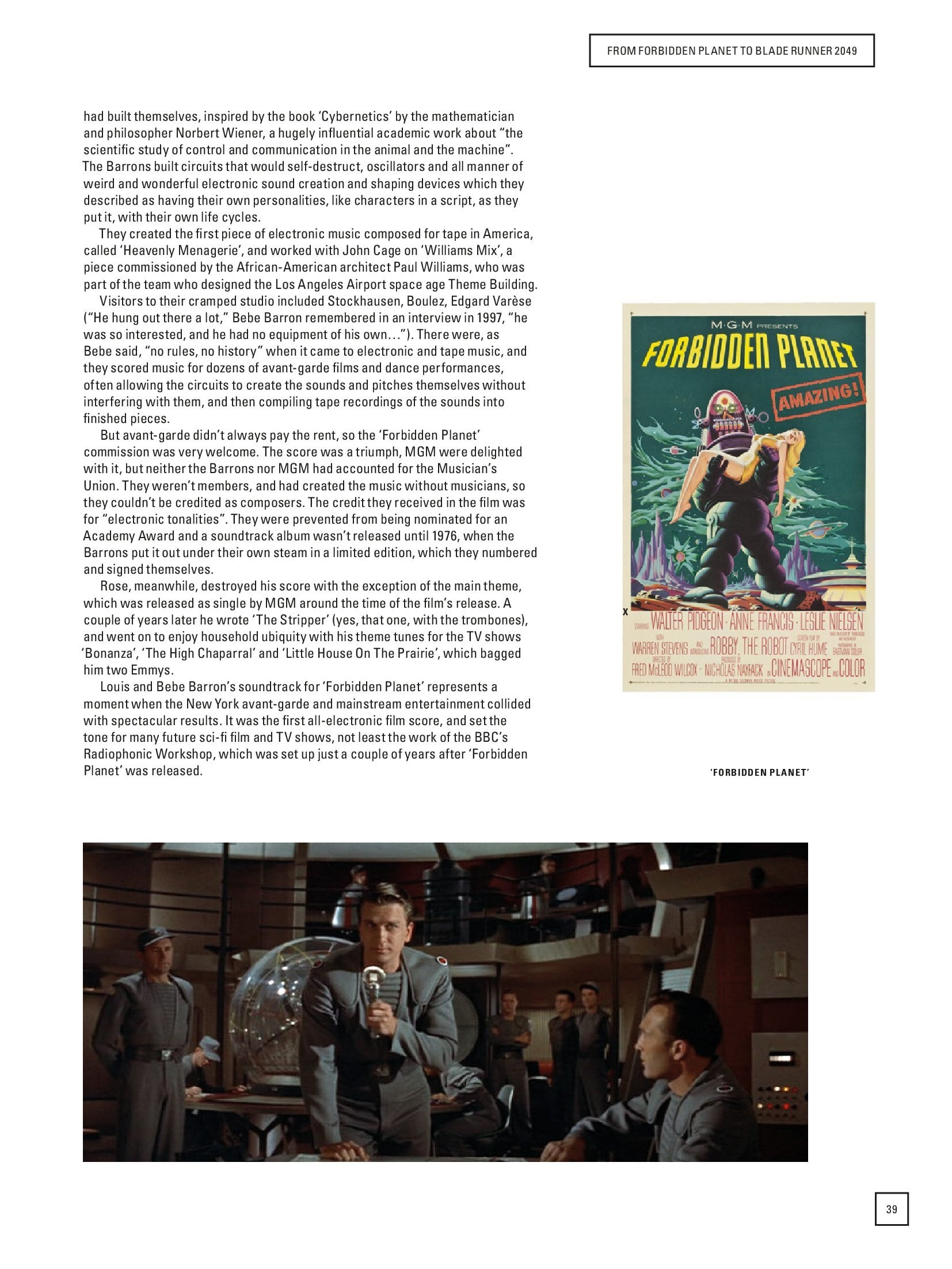
"Louis and Bebe Barron's soundtrack for 'Forbidden Planet' represents a moment when the New York avant-garde and mainstream entertainment collided with spectacular results."
- Mark Roland, Electronic Sound
Audiences didn't know it at the time, but in 1961, when they saw THE DAY THE EARTH STOOD STILL at their local theater, they were watching what would become one of the greatest science-fiction movies ever filmed. They also experienced an otherworldly soundtrack made with what was then a largely unknown device called the theremin. Invented by science wizard Leon Theremin, the unassuming box on a stand with what looked like two TV antennas sprouting from it created some of the weirdest sounds to ever come out of a musical instrument. Composed by Academy Award-winner Bernard "Psycho" Herrmann, it was the perfect sonic backdrop for Robert Wise's cautionary tale.
This was, however, not the first time the theremin had been heard in a genre film (the first time it was used for a soundtrack was in the 1930 Russian film ODNA); it was employed a decade earlier in 1951 by composer Dimitri Tiomkin for THE THING FROM ANOTHER WORLD, and Jack Arnold's IT CAME FROM OUTER SPACE (1953, with the score supervised by Joseph Gershenson). It has since been used a multitude of times whenever a touch of the eerie is needed.
As soundtracks evolved into more sophisticated arrangements, experimental, atonal and random electronic sounds were replaced by orchestral synthesizer pads and ambient washes (there are exceptions, of course), with notable contributions by artists such as Tangerine Dream and Vangelis. Rock music began to be used extensively as well and it's not uncommon these days to hear a rock song being played at the beginning or during a film.
We have to go back to the 1940's for the origins of the first all-electronic film score. Music graduates and Greenwich Village residents Louis and Bebe Barron were seriously interested in creating electronic sounds. When they married, they received a tape recorder from Louis' cousin for a present which was highly likely the only one anybody owned in New York City at the time.
The first tape recorders were secretly developed in Nazi Germany during WW II, so that officials could record Hitler's speeches and replay them to the public. At the end of the war, the U.S. seized the technology and developed it further in the States.
Along with oscillators and other electronic equipment, the Barron's used their recorder to tape their compositions for playback. In fact, they are considered the first to ever record electronic music to tape, a composition titled, "Heavenly Menagerie". Over the next few years, the couple composed scores for avant-garde films and dance performances for New York's artistic elite.
In 1955 they were approached by MGM to provide their oddly creative music for their new science-fiction film, FORBIDDEN PLANET. The Barron's were happy to comply, especially because they needed the money! The movie was released in 1956 with the first-ever all-electronic film score. The rest, as they say, is cinema history.
The article below from ELECTRONIC SOUND magazine (#34, October 2017) covers the evolution of science-fiction soundtracks from the Barron's to BLADE RUNNER 2049. Included is a review of a compilation of John Carpenter's film soundtracks.